 By Bella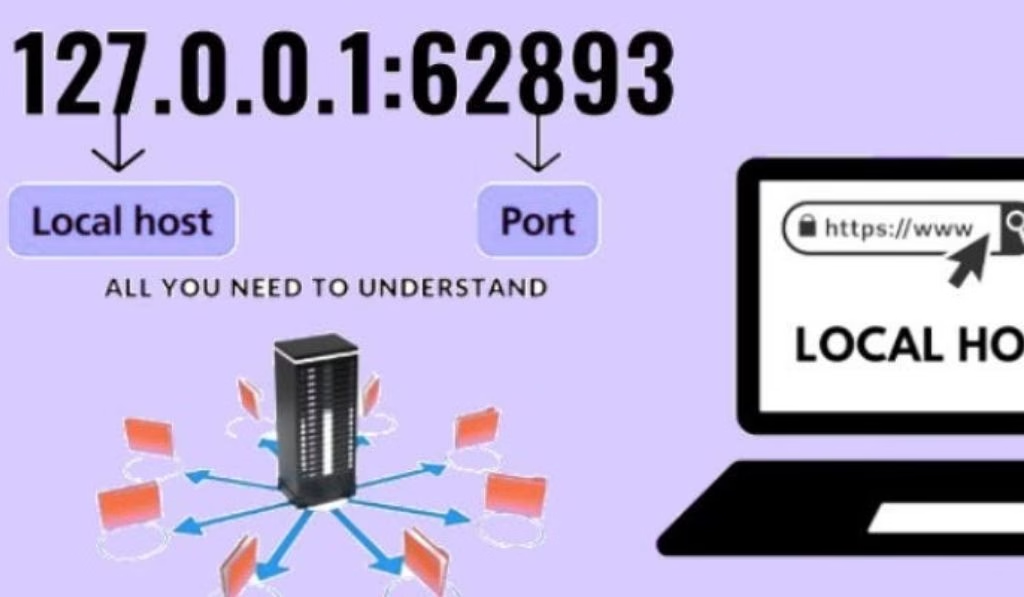
It is no secret that you have been shown 127.0.0.1:62893 on your screen. This address appears regularly to developers, network engineers, and even ordinary users with local servers.
At first it seems confusing, but it is basically just a combination of a loopback IP address and a port number that your computer uses to communicate with itself. You will find out here what 127.0.0.1:62893 refers to, how to debug it, what common errors it gives, and how to fix it in 2026.
What Is 127.0.0.1:62893?
The IP address of the loopback is 127.0.0.1, also known as localhost. Every computer has it. It is a reserved IPv4 address identified by RFC 5735 and continuously points to the same machine you are currently working on.
The :62893 part is the port number. Ports are like doors on your computer, and each one deals with a different kind of network traffic.
Port 62893 is a high-range ephemeral port, also known as a dynamic port, that is generally temporarily allocated by the operating system when an application tries to send or receive data locally.
So 127.0.0.1:62893 means there is a local service or application running on your system at port 62893, and your system is attempting to connect with it.
| Component | Value | Meaning |
| IP Address | 127.0.0.1 | Loopback / Localhost |
| Port | 62893 | Ephemeral / Dynamic Port |
| Protocol | TCP/IP | Communication standard |
| Scope | Local only | Never leaves your machine |
| IPv6 Equivalent | ::1 | Same loopback concept |
What Does the Loopback Address Do?
The loopback interface is a special network interface of your operating system. Whenever any application transmits information to 127.0.0.1, the information does not go through your network card or router. It comes right back into your machine.
Here is the simple flow:
- A request is made to 127.0.0.1:62893 by an application on your computer.
- It is immediately intercepted at the loopback interface by the OS.
- The information is redirected back to the same machine.
- An app at port 62893 receives the data and replies.
That is the reason why localhost is so fast, it has no network latency at all.
Why Do Applications Use Port 62893?
Port 62893 falls within the dynamic/private range of ports (49152 to 65535) identified by IANA (Internet Assigned Numbers Authority). These ports are automatically allocated by the OS for short-term use.
Typical uses of port 62893:
- Local development servers — frameworks like Node.js, Django, or Laravel spinning up a temporary local server.
- Database connectivity — MySQL, PostgreSQL, or Redis connecting locally during testing.
- Proxy tools — Fiddler, Charles Proxy, or Burp Suite capturing local traffic.
- IDE debugging — VS Code, PyCharm, or IntelliJ using a local debug port.
- Docker containers — dynamic port-to-host communication.
- API testing programs — Postman or Insomnia using local mock servers.
Common 127.0.0.1:62893 Errors, What They Mean, and How to Fix Them
“Connection Refused” Error
This is the most common mistake. It means your browser or application is trying to connect to port 62893, but nothing is listening there.
Causes:
- The local server has crashed or has not been started.
- The application was launched on a different port.
- The port is blocked by a firewall.
- The process terminated unexpectedly.
ERR_CONNECTION_REFUSED (Browser Error)
This browser-specific error appears when you try to visit http://127.0.0.1:62893 and no server is responding.
Causes:
- The dev server is not running.
- Incorrect port number in the browser address.
- Application did not start due to an error.
“Address Already in Use” Error
This occurs when port 62893 is already occupied by another process.
Causes:
- You ran the same application twice.
- A ghost process from an earlier session is still alive.
- Another application grabbed that port.
“Timeout” Error
A request sent to 127.0.0.1:62893 did not receive a reply in time.
Causes:
- The server is frozen or dead.
- A firewall is silently dropping packets instead of rejecting them.
- The program is stuck at a deadlock point.
How to Fix 127.0.0.1:62893 Errors (Step-by-Step)

Fix 1: Check Whether the Server Is Running
The first step is to verify that a service is actually listening on port 62893.
On Windows:
netstat -ano | findstr :62893
On Mac/Linux:
lsof -i :62893
If nothing appears, your server is not running. Start it and try again.
Fix 2: Restart the Application
Simple but effective. Shut the app down and open it again.
- Windows: Open Task Manager, locate the process, click End Task, then relaunch.
- Mac: Press Command + Q to quit completely, then reopen.
- Linux: Run kill -9 [PID] in the terminal, then restart.
Read more: Timewarp TaskUs: The Complete Guide to AI-Powered Workforce Management in 2026
Fix 3: Free Up Port 62893 if It Is in Use
If another process is using the port, kill it.
Windows:
netstat -ano | findstr :62893
taskkill /PID [PID_NUMBER] /F
Mac/Linux:
lsof -ti:62893 | xargs kill -9
Fix 4: Check Your Firewall
Your firewall may be blocking local traffic on port 62893.
- Windows: Go to the Control Panel, open Windows Defender Firewall, click “Allow an app through firewall,” and verify your application is allowed.
- Mac: Open System Settings, go to Network, then Firewall, and make sure it is not blocking local connections.
- Linux: Run sudo ufw status to check, and use sudo ufw allow 62893 to open the port if needed.
Fix 5: Clear Browser Cache
Sometimes stale cache data causes ERR_CONNECTION_REFUSED even when the server is healthy.
- Chrome: Press Ctrl + Shift + Delete and clear all.
- Firefox: Press Ctrl + Shift + Delete and clear cache.
Fix 6: Change the Port in Your Application Config
If port 62893 keeps conflicting, ask your app to use a different port.
- Node.js: Set PORT=62893 in your env file to a different value.
- Python/Django: Run python manage.py runserver 127.0.0.1:8080
- Laravel: Change the port in your Valet or artisan serve config.
127.0.0.1 vs Localhost vs 0.0.0.0 — What Is the Difference?
Many people mix up these three. Here is a clear breakdown:
| Address | Meaning | Accessible From |
| 127.0.0.1 | Loopback, refers to your local computer | Only your machine |
| localhost | Hostname that resolves to 127.0.0.1 | Only your machine |
| 0.0.0.0 | Binds to every interface | Your machine + network |
| ::1 | IPv6 loopback address | Only your machine |
A dev server bound on 127.0.0.1:62893 is not accessible to anyone outside your computer. By binding to 0.0.0.0:62893, you make it accessible to other devices on your local network.
Localhost Port Security
Although 127.0.0.1 traffic never leaves your machine, there are still some security things to be aware of:
- Cross-site request forgery (CSRF): A malicious site may be able to make requests to your localhost if your browser does not block cross-origin requests.
- DNS rebinding attacks: DNS tricks can be used to make a web page call your localhost services.
- Dev servers left open: Never bind sensitive dev servers to 0.0.0.0, always use 127.0.0.1.
- Port scanning: Certain malware scans localhost ports to determine what tools and databases you are running.
Always keep your local firewall running and do not run dev servers bound publicly on shared networks.
How to Find Your Computer’s IP Address
Need to find your actual local machine IP, not the loopback? Here is how:
Windows:
Win + R → type cmd → Enter → type ipconfig → Enter
Find the IPv4 Address under your active adapter.
Mac: Go to System Settings, open Network, click your active connection, and your IP is shown directly.
Linux:
ip addr show
or
hostname -I
FAQs About 127.0.0.1:62893
What exactly is 127.0.0.1:62893? It is a localhost address (127.0.0.1) combined with port 62893. It means local communication inside your computer is taking place on port 62893. The traffic does not leave your machine.
Is port 62893 safe? Yes, by itself it is quite safe. It is a standard dynamic port allocated by your OS. Its safety depends on what application is using it and whether that application is reliable.
Why does 127.0.0.1:62893 appear in my browser? Typically because a local development server, debugging tool, or local proxy is running and your browser is trying to access it. If you did not start such a service yourself, check what process is occupying that port.
Can 127.0.0.1:62893 be hacked externally? No. The loopback address 127.0.0.1 is not accessible from outside your machine. External attackers cannot connect to your localhost ports directly as they would need physical or remote access to your machine first.
Why is 127.0.0.1 different from my real IP address? 127.0.0.1 always refers only to your own computer. Other computers use your real IP, such as 192.168.x.x on a local network, or your public IP, to locate and access you.
How do I stop an application from using port 62893? Find the process with netstat -ano | findstr :62893 on Windows, or lsof -i :62893 on Mac/Linux, then kill it using its PID. Or simply change your app’s configuration to use a different port.
Can 127.0.0.1:62893 work without an internet connection? Yes, absolutely. Loopback communication is purely internal and does not require an internet connection or any network at all.
Final Thoughts
127.0.0.1:62893 is nothing to worry about. It is just your computer talking to itself through a temporary port. This is the kind of address developers see daily when building and testing applications on their local machines.
The key things to remember: 127.0.0.1 is your own computer, port 62893 is a dynamic port that any application can use, and most issues around this address come down to a server being offline, a port conflict, or a firewall blocking local access. Follow the step-by-step solutions in this guide and you will be able to fix the problem within a few minutes.