








To learn about electrical power, you need to begin with just one simple word that you use in your wallet on a monthly basis. All names aside, it is the units that amount to the quantity of electricity your appliances use, be it called watts or wattios.
Knowing about wattios assists you in managing power expenses, picking efficient household devices, as well as making smarter choices regarding how you utilize power in your home.
What Are Wattios
Watts are the standard unit of measurement of electrical power, and the word watts in Spanish is called wattios.
The two terms allude to the same thing and are used to describe the amount of energy that an appliance consumes or generates in one second. A 60-watt light bulb consumes 60 watts of power when switched on.
This is a rate of flow of energy and not the amount of energy used up over a period of time. Imagine it as speed on the speedometer of your car. The figure indicates your current speed and not the distance covered.
On the same note, wattios display the speed at which electricity is passing through your gadgets at any given time.
Each electrical appliance is rated in wattage, which is used to represent the amount of power used when the device is in use.
The phone charger may have a power consumption of 10 watts, whereas your air conditioner may have a power consumption of 3,500 watts. With this understanding, you would be in control of your monthly electricity bills.
The History Behind Wattios
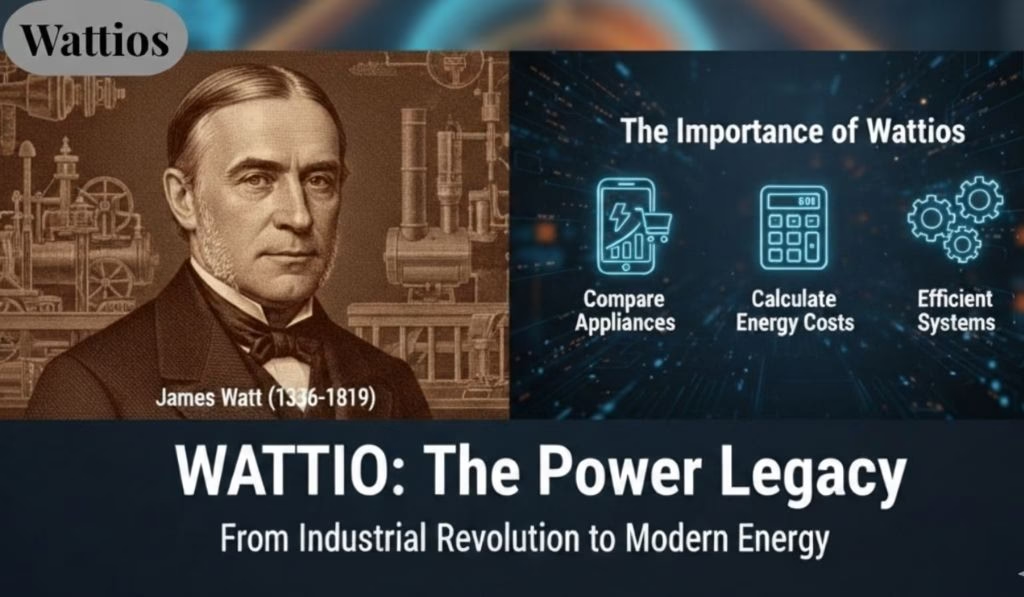
The Industrial Revolution brought about a revolution in the technology of the steam engines, and James Watt, a Scottish engineer of the 1700s, changed the technology of the steam engines. His work was important to an extent that scientists gave his name as the unit of measurement of power.
In 1879, when a standard unit of electrical power was required by the British Science Association, it decided to honor the work of Watt.
The wattio scale was made universal in all industries. Everything from phone chargers as small as they are, to power plants as big as they are, is measured in the same unit.
This standard provides an easy way to compare various appliances and also enables consumers to know clearly their energy consumption.
The Technical Operation of Wattios
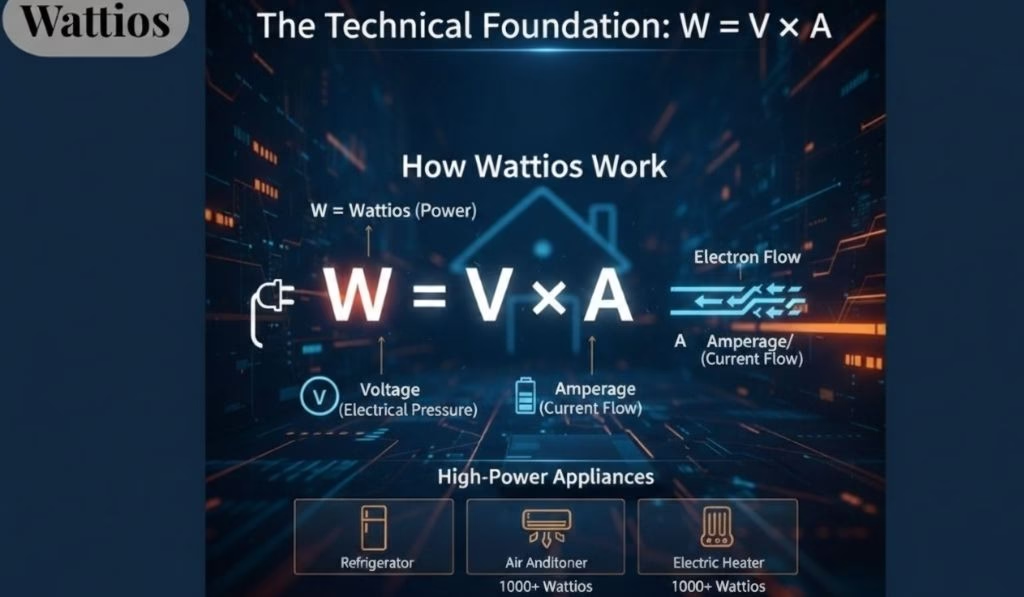
A wattio corresponds to one joule of energy passed over a second. The simple equation relates three significant measures: power equals voltage times current. This equation is one of the bases of all electrical calculations: W = V × A.
Voltage is electrical pressure which causes the movement of electrons in circuits. Current measurements are the number of electrons flowing per second. The product of the two values will give the power consumption in wattios.
An appliance that requires more voltage and current will, of course, require more wattios than one with less requirements. It may take 400 watts of power to run your refrigerator but will take 65 watts of power to run your laptop. All these differences add tremendously to your monthly bill.
Seeing the Light on LED Efficiency in Wattios
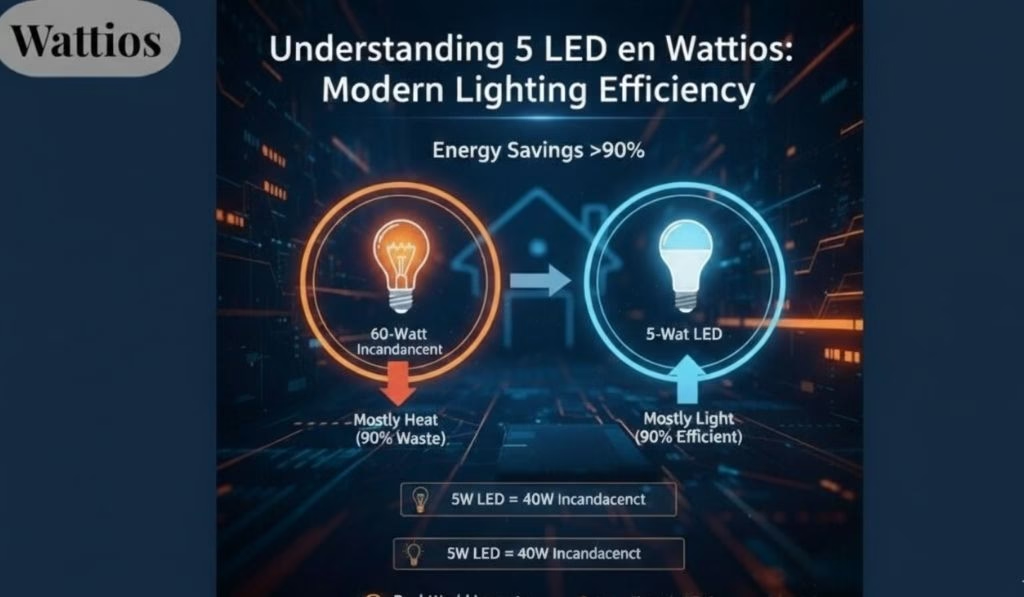
The current LED bulbs transformed the entire concept of lighting efficiency. LEDs use only 5 watts to generate the same brightness as the 40 watts of an incandescent light.
This implies that you save 88 percent of electricity consumption but still have the same amount of light output.
The conventional incandescent bulbs consumed the majority of the energy in the form of heat rather than light. They had visible light flowing out in only about 10 percent of their electricity. This was reversed by LED technology that transformed nearly all the energy into light using semiconductor materials.
The lumens and not only the wattage should be considered when purchasing LED bulbs. An LED with 10 watts can actually substitute a 60-watt incandescent.
The energy conservation is felt throughout your whole house. 500 watts of power is saved by replacing 10 60-watt bulbs with 10-watt LEDs, and lighting costs will be reduced by over 80 percent.
How to Compute Your Power Bills in Wattios
Wattage of an appliance will help you to know the precise amount of money you will spend to operate it. The calculation is easy: the device wattage times hours of use times your electricity rate.
Your utility company charges per kilowatt-hours. One kilowatt equals 1,000 watts. Assuming that you run a 1,000-watt microwave for 30 minutes, it uses 500 watt-hours, or half a kilowatt-hour.
Use a 1,500-watt space heater with 8 hours a day of use. That is 12,000 watt-hours, or 12 kilowatt-hours per day. This heater at 16 cents per kilowatt-hour translates to 1.92 dollars in a day, or approximately 57 dollars in a month. Knowing these calculations will allow you to identify your largest energy costs.
Appliances in the House and Their Wattios
Various appliances use extremely different power. This is how common domestic products consume:
Refrigerators consume 100 to 800 watts based on the size and efficiency. Newer models by the Energy Star program consume much less energy compared to older ones and will often pay back in a few years due to the lower electric bills.
Air conditioning systems consume a lot of power. The window units normally consume between 900 to 1,500 watts, and central air systems require between 2,000 to 5,000 watts when in operation. These have the most significant influence on electricity bills in summer.
There is broad variation with kitchen appliances. Coffee makers consume 900 to 1,200 watts, toasters consume 800 to 1,500 watts, and electric ovens consume 2,000 to 5,000 watts of power when in use. Microwaves usually use 600 to 1,200 watts.
Electronics of entertainment consume small amounts of power. LED TVs use 30 to 100 watts, laptop computers use 30 to 70 watts, and when recharging their phones, smartphone chargers use only 5 to 10 watts.
Water heaters are among the largest consumers of energy in the home. Electric models can demand between 3,000 to 5,500 watts during heating operations, however they do not operate around the clock.
Read more: The Hidden Cost of Stress: 7 Ways It Subtly Destroys Your Health
Shrewd Solutions to Wattios Consumption
To save power, people do not have to make significant changes in their lifestyle. Minimal changes make significant savings in the long run.
Replace all the lighting with LED bulbs. Such a change can save about three quarters to nearly half of the energy used in lighting nearly instantly. The initial investment will be recovered in a few months by reducing electricity bills.
Switch electricity off when not in use to avoid phantom power wastage. Most electronics still consume a little bit of power even when they are not in use. This is one of the vampire powers that can be used to explain 5 to 10 percent of residential consumption.
Power strips can be easily unplugged from outlets. Connect several devices to a strip and with the touch of a single switch, break power to all devices. This guarantees actual usage of zero-watt when the devices are not in demand.
Replacement of old appliances with modern models that use less energy. A 300-watt refrigerator would save hundreds of kilowatt-hours a year compared to a 600-watt one. The increased purchase price is usually compensated by the monthly savings.
Change temperatures in thermostats a few degrees. Heating and cooling systems use thousands of wattios of power to operate, and therefore a significant amount of savings is made by decreasing the run time by moderating the temperature.
Wattios and Renewable Energy Systems
The solar panels and wind turbines produce electricity in wattios like the traditional power sources. Learning power ratings can be used to analyze the renewable energy systems to be used in the home.
The output of the solar panels in residences is usually 250 to 400 watts when the sun shines. A home solar of 20 panels produces between 5,000 and 8,000 total watts at the peak of sunshine.
Power output and capacity are used to classify battery storage systems. These requirements define the capacity of energy that is stored in a battery and the rate at which the battery supplies power to the devices being connected to it.
The net metering programs enable the homeowners to feed back the additional generated power into the electrical grid. With wattio production knowledge, the systems are optimized, and financial benefits of renewable installations are optimized.
Energy Efficient Appliances: How to Select Them
Wattage should be one of the major considerations during the purchase of new appliances in addition to features and cost. Less wattage models save on the current operational costs during the lifetime of the appliance.
Energy labels offer uniform data concerning the power usage in the daily conditions of use. The labels enable one to make direct comparisons of similar appliances and therefore find the most efficient ones.
In certain instances, it is economically viable to pay more initially in order to buy an appliance with less power. Divide the cost of energy difference of the anticipated product life and decide on the efficiency upgrades that may need to be higher purchase prices.
The manufacturer specifications may occasionally provide various power ratings of various operating modes.
A washing machine may consume 500 watts of power when it is used as a washing machine, but it may just consume 50 watts when it is spinning. The knowledge of such variations can be useful in estimating the overall energy consumption.
FAQs About Wattios
What is the watts to kilowatts difference?
One kilowatt equals 1,000 watts. Kilowatts are used to measure greater power quantities of large appliances and the whole house use. Your electricity bill indicates that you use kWh of electric power, or that is kilowatts per hour.
Going by a typical home, what are the watts consumed?
The average American family consumes approximately 877 kilowatt-hours of power per month, which equates to approximately 1,200 watts of constant power. During cooking or cooling time, it may go up to 5,000 to 10,000 watts.
Are LED bulbs really that energy saving?
Yes. The same level of brightness requires 75 to 90 percent less energy than with incandescent bulbs. An LED consuming 10 watts generates an equivalent of 60-watt incandescent and consumes 50 watts less per bulb.
How should I determine my monthly electricity bill?
Divide the total sum of all the watts of your appliances by 1,000 watts per day to determine the kilowatt-hours of the appliances. Multiply this sum with 30 days and then multiply that by your electricity rate per kilowatt-hour. Add all appliances and get the total monthly expense.
Which appliances consume the largest amount of wattios?
The most power consuming systems are heating and cooling systems. Next come water heaters, electric ovens, clothes dryers, and refrigerators. Home use of air conditioners is enough to create 17 percent of the summertime energy consumption in the home.
Is it possible to use an LED bulb with more wattage in my light?
No, only to an extent that the real wattage does not exceed the maximum wattage of your fixture. The label on an LED that reads 60-watt equivalent has as much as 10 actual watts, thus is safe in a 60-watt maximum lamp.
What is phantom power and how much does it cost?
The electricity used by the plugged devices that are not on is called phantom power. It may contribute 5 to 10 percent of household energy consumption, which the typical household would spend between $100 to $200 a year. This waste is eliminated by disconnection or use of power strips.
How to Take Charge of Your Electric Bills
Knowledge of wattios gives you the strength to control the use of energy and expenditure. The power rating of any device is an opportunity to make a right choice that suits personal finances and the environment.
Even little things would lead to great savings in the long run. Substituting inefficient light, disconnection of idle appliances, and low wattage of appliances all lead to less electricity consumption and environmental influence.
Wattios knowledge will help you to turn abstract electricity usage into manageable, tangible numbers that you can act on now.