







You are not the only one who has ever asked yourself what chalanting is. It has been appearing in discussions, social media, and even gaming circles, but it is not even mentioned in the majority of dictionaries.
Chalanting is the active form of chalant, which itself is a back-formation of nonchalant, meaning someone who is observably caring, active, and attentive. This guide dissects the full definition of chalanting, its origin, real life applications, and everything that others have overlooked.
What Does Chalanting Mean?
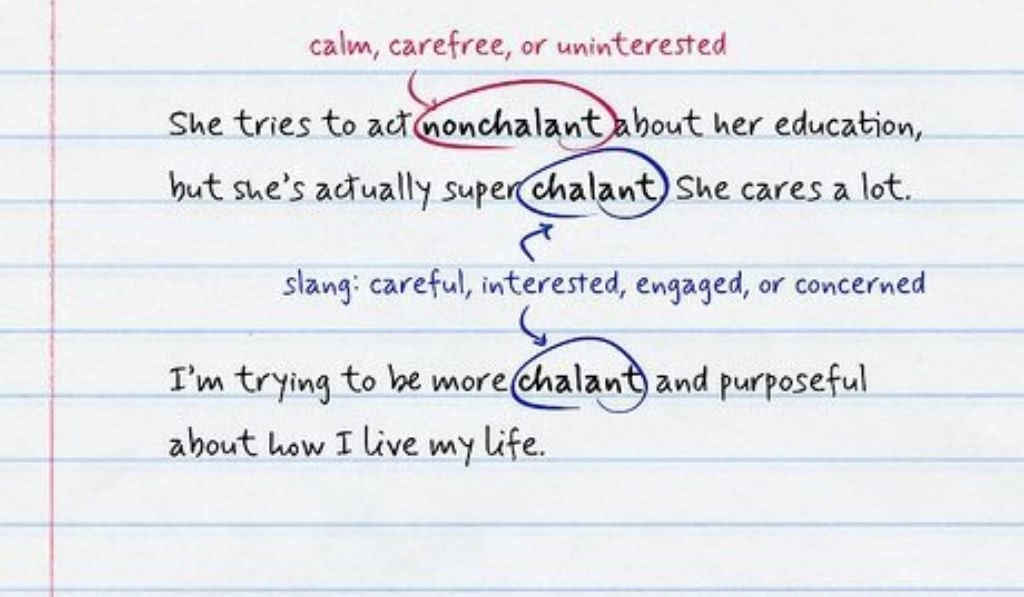
Chalanting means being present, caring, concerned, and completely engaged with something. It is the active form of chalant, so you are not merely a careful person in theory, but you are actually demonstrating it right now, in the moment.
Think of it this way:
- Chalant = the state of being conscientious or caring.
- Chalanting = actively being that way, in the present.
It is a colloquial term that does not appear in official dictionaries like Merriam-Webster or Oxford. But it exists and is popular, particularly on the internet.
Example: “I am so chalant about my editing, and whatever I do, I do it very chalantly.” This quote is from Dream, the Minecraft YouTuber who popularized the term.
Where Did Chalanting Come From? (The Real Etymology)
The Back-Formation Story
Nonchalant was borrowed into English from Old French. The French word chaloir meant “to care” or “to bother oneself.” The prefix non- was added to indicate the opposite, meaning unconcerned, relaxed, or indifferent.
The twist is that there was never actually a standalone word “chalant” in English. Nonchalant was imported as one complete word from the French nonchaloir, meaning “to disregard.” But English speakers did something clever, they treated non- as a prefix and logically formed chalant as its opposite.
Even though linguists may debate its validity, the reasoning makes sense and reflects how the English language has historically developed.
Chalanting followed naturally as the present participle of this back-formed word.
How It Spread
It gained popularity when Dream, one of the biggest Minecraft YouTubers, used the term, saying he was very chalant about his editing and that he does everything very chalantly. That moment pushed the word into internet culture, where it now fits comfortably in slang, humor, and informal writing.
Chalant vs. Nonchalant: A Full Comparison
| Feature | Chalant / Chalanting | Nonchalant |
| Origin | Back-formed from nonchalant | Old French nonchaloir |
| Meaning | Worried, attentive, invested | Calm, carefree, indifferent |
| Dictionary Status | Informal / slang | Fully standard word |
| Tone | Serious, invested, present | Cool, composed, detached |
| Common Context | Work ethic, personal care | Composure, social coolness |
| Grammar | Adjective (chalant) / Verb form (chalanting) | Adjective only |
The key takeaway is that while nonchalant means indifferent or calm, chalant and chalanting mean concerned, attentive, and emotionally involved.
Real-Life Examples of Chalanting
Here is how you would actually use chalanting in sentences:
At Work:
- She always chalants at meetings, asks questions, takes notes, and follows up.
- He was really chalanting on that project, staying three nights late to get it right.
In Relationships:
- I like that he is chalanting, he notices the little things and checks in regularly.
Online / Humor:
- You do not need to be so chalanting about the group chat rules.
- Stop chalanting so much, it is just a meme.
In Creative Writing:
- Unlike the nonchalant tourists passing by, she was chalanting, photographing every tile and asking each vendor their name.
Is Chalanting a “Real” Word? The Honest Answer
Here is what you should know, and what most articles fail to mention.
Merriam-Webster is clear that chalant is not a standard English word. It does not appear in official dictionaries. But that does not make it meaningless. Language does not only exist in dictionaries.
Chalant has found a place in humor, creativity, and casual conversation. People use it to describe someone who is openly invested or visibly caring, and it works socially whether or not it is officially recognized. Think of words like irregardless, frustrated, or adulting, all common, all informal. Chalanting is no different.
Bottom line: It works perfectly fine in informal speech, social media, and humorous writing, but should not be used in academic writing.
Read more: Acamento: The Complete Guide to Finishing That Separates Good Work from Great Work
Pronunciation Guide
Most people are unsure how to say these words. Here is a quick reference:
| Word | Pronunciation | Sounds Like |
| Chalant | SHA-lant | “shuh-LANT” |
| Chalanting | SHA-lan-ting | “shuh-LAN-ting” |
| Nonchalant | non-shuh-LANT | “non-shuh-LANT” |
The ch sounds like the sh in “shell,” following the French pattern of pronunciation.
Synonyms and Alternatives for Chalanting
If you want a word that carries the same meaning in a more formal way, here are the best options:
- Attentive, paying close attention and observing carefully.
- Engaged, active, involved, and invested.
- Industrious, careful and hardworking.
- Conscientious, doing things the right way.
- Earnest, serious and genuinely purposeful.
- Zealous, enthusiastic and energetic.
- Mindful, aware and attentive to details.
Informal alternatives include: try-hard, extra, invested, locked in.
Common Misconceptions About Chalanting
Misconception 1: “Chalanting means being careless.” Completely wrong. Chalanting is the opposite of careless, it means visible effort and care.
Misconception 2: “It is a typo of the word enthralling.” No. Chalanting is a deliberately coined word from chalant. Entirely different meanings.
Misconception 3: “Since nonchalant exists, chalant must be its official root.” Chalant is a back-formation. English speakers assumed nonchalant had a root word and reconstructed it. It is a reconstruction, not an inherited word.
Misconception 4: “Being nonchalant is always negative.” Not at all. Being nonchalant can mean staying cool under pressure, which is often a good thing. It only becomes negative when a situation calls for concern and none is shown.
Chalanting in Pop Culture and Social Media
The term has quietly but persistently shown up across platforms:
- Gaming / YouTube: Dream’s use of chalantly sparked real curiosity and led to thousands of searches.
- TikTok: The word appears in language-humor content about the quirks of the English language.
- Twitter/X: Used jokingly, such as “I am chalanting about this TV show finale and it is embarrassing.”
- Reddit: Comes up in posts about unusual English words and back-formations.
It fits well into internet culture’s love of ironic sincerity, where something that sounds overly formal is used to describe genuine emotional investment.
Final Thoughts
Chalanting fills a real gap in everyday vocabulary. English is a quirky language, and nothing quite captures the opposite of nonchalant the way this word does. “Concerned” or “attentive” simply do not carry the same energy.
Chalanting paints a picture, this person cares, they are showing it, and they are not apologizing for it. Whether used seriously or with a wink, it is a word worth keeping in mind in 2026.
Frequently Asked Questions (FAQs)
What does chalanting mean? Chalanting means actively caring, being concerned, or giving full attention to something. It is the present participle of chalant, informally used to describe someone who is visibly invested.
Is chalanting a real word? It does not appear in standard dictionaries. It is an informal term coined through a back-formation of nonchalant. Still, it is widely understood and commonly used online.
What is the difference between chalant and nonchalant? Nonchalant means carefree and indifferent. Chalant is the reverse, attentive, engaged, and caring. The act of being chalant is called chalanting.
Who coined the term chalanting? The Minecraft YouTuber Dream is the most well-known example of someone who popularized the word chalantly in modern internet culture, using it to describe his dedication to his work.
What is a synonym for chalanting? The closest formal synonyms are industrious, attentive, or earnest. In slang, expressions like “being extra” or “trying hard” carry similar weight.
Can I use chalanting in formal writing? Not recommended. It is a back-formed slang word. In professional or academic settings, use attentive, engaged, or conscientious instead.