







Timing is one of the most common questions parents have when orthodontic treatment for their teenager comes up. Start too early and the teeth may still be shifting as permanent ones continue to come in. Wait too long and certain corrections become more complicated. Getting the timing right makes treatment more straightforward, more effective, and often shorter.
The teenage years are widely considered the most favourable window for comprehensive orthodontic treatment. The jaw is still growing, most or all of the permanent teeth have arrived, and the body responds to orthodontic force more readily than it will in adulthood. That combination of factors creates conditions where teeth move more predictably and bone adapts more efficiently to the changes being made.
According to the American Association of Orthodontists, the majority of comprehensive orthodontic treatment begins between the ages of 11 and 14. But that range is not a rigid rule. The right start time for any individual teenager depends on several factors that an orthodontist assesses before recommending when to begin. This article walks through those factors, what the assessment involves, and what parents and teenagers can expect from treatment that starts at the right time.
1. Why the Teenage Years Are the Ideal Treatment Window
Orthodontic treatment works by applying controlled force to the teeth, which causes the bone around the tooth roots to remodel. Bone on one side of the root breaks down to allow movement, while new bone fills in behind the tooth as it shifts. This process happens at every age, but it happens faster and more efficiently in younger patients whose bone is still actively developing.
Active Jaw Growth as an Advantage
During the teenage years, the jaw continues growing, and that growth can be guided and used to the patient’s advantage. An orthodontist can time treatment to work with natural jaw development rather than against it, using the growth that is already occurring to achieve corrections that would require much more effort in a fully developed adult jaw. Overbites, underbites, and narrow arches all respond better to treatment when some jaw growth remains available to work with.
Most Permanent Teeth Have Arrived
Comprehensive orthodontic treatment is most effective when the full set of permanent teeth, or nearly all of them, are present. Trying to align teeth while others are still erupting creates a moving target that complicates treatment planning. By around age 12 to 13, most teenagers have their permanent teeth in place, which gives the orthodontist the complete picture needed to plan and execute treatment from start to finish without interruption.
2. The Key Factors That Determine the Right Start Time
The 11 to 14 age range is a guideline, not a deadline. For some teenagers, starting at 11 is appropriate. For others, waiting until 13 or 14 produces better outcomes because the teeth and jaw are at a more favorable stage. The orthodontist considers several specific factors before making a timing recommendation.
Eruption Status of the Permanent Teeth
The single most important factor in timing is whether enough permanent teeth have erupted to allow comprehensive treatment to begin. If second molars or other key teeth are still well below the gum line, starting treatment before they arrive may mean the braces need to be on longer than necessary while waiting for those teeth to come through. The orthodontist uses X-rays to assess the position and development of teeth that are not yet visible, which informs whether the timing is right or whether a short wait will produce a better starting point.
The Severity and Type of the Orthodontic Problem
Some conditions carry more urgency than others. A significant overbite or underbite that is affecting jaw development or causing wear on the teeth may warrant earlier intervention than a case of mild crowding that can wait until the permanent teeth have fully settled. The type of problem being treated influences both the ideal start time and the sequence of treatment steps, which is why an individual assessment is more informative than any general age guideline.
The Teenager’s Maturity and Compliance Readiness
Orthodontic treatment requires consistent cooperation from the patient. Braces need to be kept clean. Dietary restrictions need to be followed to avoid damaging the appliances. Clear aligners need to be worn for the required hours each day. A teenager who is not yet ready to take responsibility for these requirements may have better outcomes if treatment is delayed slightly until their maturity level supports better compliance. A frank conversation between the orthodontist, the parent, and the teenager helps identify where the patient stands on this.
3. What Happens at the Initial Orthodontic Assessment
Before any treatment recommendation is made, the orthodontist carries out a comprehensive assessment that goes beyond looking at the teeth. This evaluation gives a complete picture of the current state of development and identifies exactly what needs to be corrected and in what order.
Clinical Examination and X-Rays
The orthodontist examines the teeth, gums, and jaw visually and uses X-rays to assess root positions, bone levels, and the development status of any teeth that have not yet fully erupted. A panoramic X-ray shows the full dental arch in a single image, revealing the position of all teeth including wisdom teeth. A cephalometric X-ray taken from the side of the head allows the orthodontist to measure jaw angles and relationships that determine how the bite is functioning and what corrections are needed.
Digital Scans and Treatment Planning
Many orthodontic practices now use digital intraoral scanners instead of traditional impressions to capture a detailed 3D model of the teeth. This model is used to plan treatment, show the patient what the expected outcome will look like, and in the case of clear aligner treatment, fabricate the aligners themselves. The initial assessment appointment ends with a clear treatment recommendation that covers the proposed approach, the expected duration, and the timing for beginning.
Families considering Peabody orthodontics for teens will find that the initial assessment is a thorough process that gives both parents and teenagers a clear understanding of what treatment involves before any commitment is made. The orthodontist will answer questions about timing, treatment options, and what to expect at each stage of the process.
4. Treatment Options Available for Teenagers
Once the assessment confirms that the timing is right to begin, the next decision is which type of orthodontic treatment is most appropriate. Teenagers today have more options than previous generations, and the right choice depends on the complexity of the case, the teenager’s lifestyle, and their preferences.
Traditional Metal Braces
Metal braces remain the most reliable option for complex cases involving significant bite correction, severe crowding, or tooth rotation. They give the orthodontist precise control over tooth movement in three dimensions and work continuously without requiring patient compliance beyond keeping them clean. For teenagers with complex cases, metal braces often produce the most predictable result in the shortest time. They are also the most durable option for active teenagers who play contact sports or are generally harder on their dental appliances.
Ceramic Braces
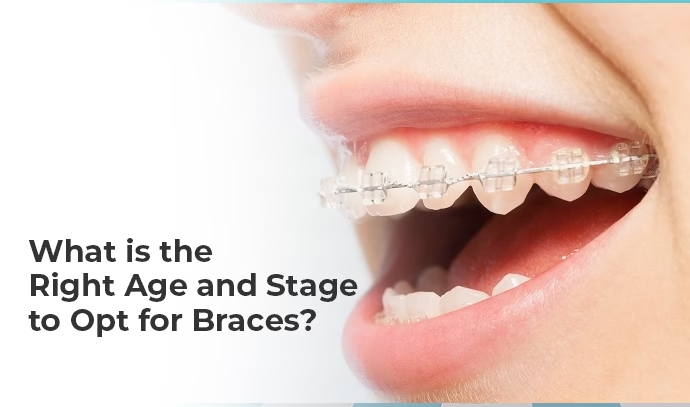
Ceramic braces use tooth-coloured brackets instead of metal, making them considerably less visible while providing the same mechanical function as traditional braces. They are a popular choice for teenagers who are self-conscious about the appearance of metal brackets. The brackets are slightly more fragile than metal and can stain if dietary habits are not managed, but for patients who take care of them, ceramic braces offer a practical middle ground between visibility and effectiveness.
Clear Aligners for Teens
Clear aligner systems designed specifically for teenagers include features that account for the compliance challenges of this age group. Compliance indicators built into the aligners change colour with wear, giving parents and orthodontists a way to assess whether the trays are being worn for the required 20 to 22 hours daily. Some systems also include additional aligners to account for the occasional lost or damaged tray. Clear aligners are well-suited for mild to moderate cases and for teenagers who are disciplined enough to wear them consistently.
5. What to Expect During Teen Orthodontic Treatment
Understanding what the treatment period involves helps teenagers and parents prepare for the experience rather than being surprised by it. Comprehensive orthodontic treatment for teenagers typically lasts between 18 months and 30 months, depending on the complexity of the case and how consistently the patient follows instructions.
Regular Adjustment Appointments
For teenagers in braces, adjustment appointments happen every four to eight weeks. At each visit, the orthodontist checks progress, replaces the elastic ties, and may adjust the wire to continue applying the appropriate force for the current stage of treatment. These appointments are typically short, around 20 to 30 minutes, and are where most of the active treatment decisions are made. Consistent attendance at adjustment appointments is directly linked to staying on schedule and finishing treatment on time.
Managing Discomfort During Treatment
Soreness after adjustments is a normal part of braces treatment and typically peaks within the first 48 hours of a new wire or adjustment. Over-the-counter pain relief taken as directed manages most of the discomfort effectively. Soft foods during the first few days after each adjustment reduce the pressure on teeth that are actively moving. Most teenagers adapt to the cycle of adjustment soreness within the first few months and find subsequent adjustments significantly easier to manage than the initial ones.
6. Life After Braces: The Retention Phase
Treatment does not end when the braces come off. The retention phase that follows is just as important as the active treatment phase, and skipping it leads to one of the most common and frustrating outcomes in orthodontics: teeth shifting back toward their original positions after all the work to correct them.
Why Teeth Move After Braces
When braces are removed, the bone around the tooth roots is still settling into its new configuration. The periodontal fibres connecting the teeth to the bone have a memory and tend to pull teeth back toward where they came from if not held in place. This is not a flaw in the treatment. It is a predictable biological response that the retention phase is specifically designed to counteract. Without a retainer, some degree of relapse is almost inevitable, particularly in the first year after treatment ends.
Types of Retainers and How Long to Wear Them
Retainers come in two main types: removable retainers worn at night and fixed retainers bonded to the back of the front teeth. Many orthodontists recommend a combination of both for teenagers. The fixed retainer provides constant passive retention for the front teeth where relapse is most visible, while the removable retainer maintains the overall arch form. Retainer wear is typically full-time for the first few months after braces are removed, then transitions to nights only for the long term. For most patients, some form of retainer wear continues indefinitely to maintain the result.
Parents researching Peabody orthodontics for teens should factor the retention phase into their expectations from the start. A practice that takes retention seriously will explain the plan for keeping the result stable before treatment even begins, and will follow up consistently to check retainer fit and compliance throughout the post-treatment period.
Frequently Asked Questions
Is 16 too late to start orthodontic treatment as a teenager?
No. While the most common window for starting is between 11 and 14, beginning at 16 is entirely appropriate and common. A 16-year-old typically has all or nearly all of their permanent teeth present, and jaw growth, while slowing, is still active enough to support effective treatment. The main difference from starting at 12 or 13 is that some growth-related corrections may be less straightforward, but the vast majority of alignment and bite issues are fully treatable at 16. An orthodontic assessment will give a clear picture of what is achievable and how long treatment is expected to take.
What if my teenager has wisdom teeth coming in during treatment?
Wisdom teeth erupting during orthodontic treatment is a common situation. In most cases, they do not significantly affect the treatment outcome if the case is well-planned. The orthodontist will monitor wisdom tooth development through X-rays throughout treatment and advise whether removal is recommended before, during, or after braces. The decision depends on the position of the wisdom teeth, the amount of space available, and whether they are likely to cause crowding after treatment. Your orthodontist will guide you through this if it becomes relevant.
Can a teenager with braces still play a musical instrument?
Yes, though some adjustment time is needed. Wind and brass instrument players may find the brackets affect their embouchure initially, but most adapt within a few weeks. Orthodontic wax placed over sharp bracket edges can help with lip discomfort during the adjustment period. Students who play instruments should mention this to their orthodontist at the initial assessment so bracket placement can take lip pressure into account where possible.
How do I keep my teenager motivated to wear their retainer after braces?
The most effective motivation is showing teenagers the before-and-after comparison of their own teeth and connecting retainer wear directly to protecting that result. Teenagers who understand that skipping the retainer means their teeth will shift back tend to be more compliant than those who are simply told to wear it without context. Building the retainer into a consistent nightly routine, keeping a spare at school or in a sports bag, and scheduling regular retainer check-ins with the orthodontist all support long-term compliance.
Conclusion
The teenage years offer a window for orthodontic treatment that combines active jaw growth, the presence of most permanent teeth, and bone that responds efficiently to orthodontic force. That combination makes treatment during this period more effective and often shorter than treatment started in adulthood. The specific timing within those years depends on eruption status, the type and severity of the problem, and the teenager’s readiness to cooperate with treatment.
An orthodontic assessment gives families the information needed to make a confident timing decision rather than guessing. Whether treatment starts at 11 or 15, what matters most is that it begins at the point where conditions support the best possible outcome for that individual patient.
If your teenager has not yet had an orthodontic evaluation, scheduling one is the most straightforward first step. The assessment will tell you exactly where things stand, whether the timing is right to begin, and what the treatment plan will look like from start to finish.